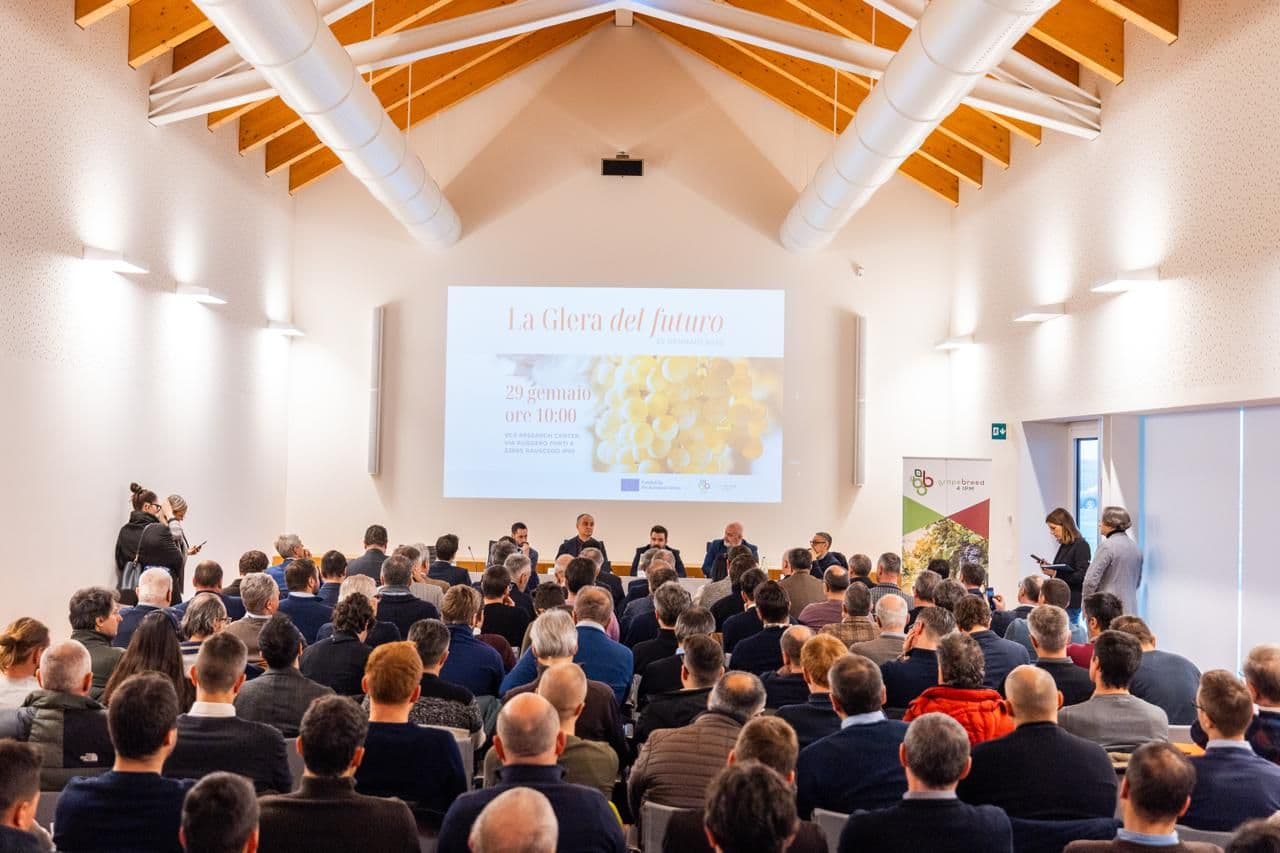
Seven new resistant varieties, descendants of Glera, ready to strengthen the prospects of the flagship product of Italian wine exports: Prosecco DOC and DOCG.
They were officially presented on January 29 during the event “The Glera of the Future”, organized by VCR – Vivai Cooperativi Rauscedo at the VCR Research Center in Rauscedo (PN), in front of an audience of more than 200 producers, technicians, researchers and institutional representatives.
The innovation agenda
Four of these varieties originate from VCR’s autonomous breeding program and are at an advanced stage of registration in the Italian National Variety Register, with availability expected between February 2026 and the end of 2027. The other three derive from the research activity of CREA Viticulture and Enology in Conegliano (TV) and will be available starting from the end of 2027.
The event was also an important opportunity to discuss not only technical aspects, but also current issues, future scenarios and market trends, thanks to the presence of the Consortia Prosecco DOC, Conegliano Valdobbiadene Prosecco Superiore DOCG, Asolo Montello DOCG and Colli Euganei DOCG. Together, they safeguard the largest denomination-based wine system in Italy, covering a territory that stretches “south from Trieste”, encompassing the whole of Friuli Venezia Giulia and Veneto down to the province of Padua.
The advantages of a varietal range
“Having a range of resistant varieties available,” explained Yuri Zambon, Director of VCR, “means being able to respond to the diverse needs of different territories and to different winemaking expressions, while keeping the identity of Glera at the center.”
The varieties presented belong to the PIWI family, resistant to the main fungal diseases of grapevine such as downy mildew and powdery mildew.
“Resistant varieties,” emphasized Denis Pantini of Nomisma, “represent a concrete response to the growing demand for sustainability and lighter wines expressed by new generations of consumers worldwide.”
Their use allows for a significant reduction in the use of plant protection products, especially near residential areas, improving the relationship between viticulture, the environment and local communities.
“Fewer inputs, better outputs,” added Riccardo Velasco, Director of CREA VE. “Today, genetic improvement, together with digitalization and less impactful plant protection strategies, is the most effective path to combine production needs with the protection of health and the environment.”
These new varieties also provide a tangible response to the challenges posed by climate change and represent a powerful driver of innovation and brand enhancement for the denominations.
The Consortia’s perspectives
“These are not varieties alternative to Glera,” stated Diego Tomasi, Director of the Conegliano Valdobbiadene DOCG Consortium. “They are Glera adapting to the future.”
“If we want to protect unique landscapes where vineyards are the main feature,” added Michele Noal, President of Asolo Montello DOCG, “we must allow Glera to defend itself.”
“Our territory,” highlighted Gianluca Carraro for Colli Euganei DOCG, “stands for real sustainability, not just declared sustainability. Resistant varieties are the most coherent tool to keep this promise.”
Characteristics of the new varieties
The oenological and sensory traits of the new varieties respond to different production needs:
- Glera-R-VCR-2: sugar accumulation, acidity, aromatic complexity
- Glera-R-VCR-4: acidity, freshness, sapidity
- Glera-R-VCR-5: maximum varietal typicity
- VCR-15-1-1-99: acidity and aromatic intensity
- VE 7_3_8 (Glaurum), VE 09_11_02, VE 13_04_05: productivity, freshness, oenological flexibility
All are characterized by high polygenic resistance to downy mildew and powdery mildew.
“Here at the VCR Research Center,” stated Alessandro Leon, President of VCR, “we are not presenting an idea, but something that has already existed in our fields for over five years: a concrete opportunity for sustainability, quality and innovation at the service of Italian viticulture.”
A regulatory challenge
“The Glera of the future already exists. Now it must also be allowed to exist within the rules,” commented Director Zambon. “Today, Italy is the only European country that does not allow the use of resistant varieties in DOC wines, due to the constraint set by Article 33, paragraph 6 of the Consolidated Wine Law. This regulatory limitation is currently under review by Parliament and Government. The strong institutional presence and attention shown in Rauscedo gives hope for a regulatory update consistent with the evolution of research, environmental needs and market expectations.”
Institutional presence
Present at the event to inaugurate “The Glera of the Future” were:
- Stefano Zannier, Regional Councillor for Agri-food, Forestry and Fisheries Resources of Friuli Venezia Giulia
- Michele Zanardo, President of the National Committee for PDO and PGI Wines
- Anna Maria Cisint and Alessandro Ciriani, Members of the European Parliament
- Michele Leon, Mayor of San Giorgio della Richinvelda
The Presidents of the Regions of Friuli Venezia Giulia and Veneto, Massimiliano Fedriga and Alberto Stefani, sent their greetings and expressed their support for viticultural innovation through two messages read at the opening of the event.


